


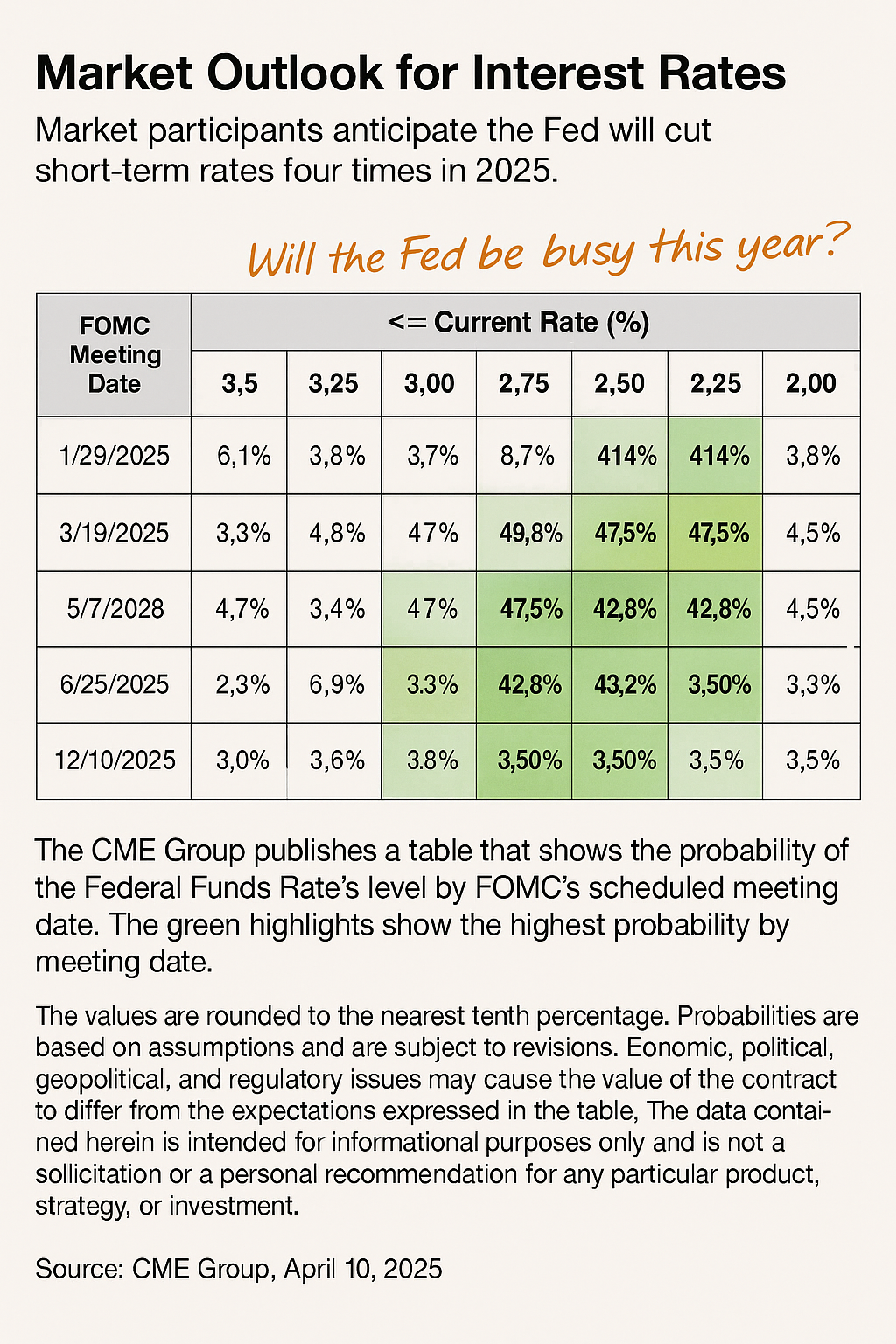
The Federal Reserve (Fed) is anticipated to adjust interest rates four times in 2025, potentially reducing the current federal funds rate of approximately 4.33%. While these expected rate cuts usually dominate financial news, ongoing economic uncertainties—including inflation trends, tariff discussions, and market volatility—have complicated investor perspectives.
The CME Group’s Projections and Market Expectations
According to recent data from the CME Group (April 10, 2025), market participants show strong confidence in rate reductions beginning as soon as the Fed’s May meeting, with a 71.8% probability forecasted (CME Group, April 10, 2025). This suggests investors are positioning for imminent action by the Fed to address current economic conditions.
Balancing Inflation Concerns and Tariff Risks
Inflation metrics provide the backdrop for these anticipated rate cuts. For example, core inflation moderated to an annual rate of 2.8% in March, signaling potential room for the Fed to ease monetary policy (U.S. Bureau of Labor Statistics, March 2025 CPI Report). However, looming uncertainties about tariffs and international trade pose inflationary risks. Tariffs typically raise consumer goods prices and production costs, possibly triggering higher inflation that could complicate decisions to lower interest rates.
Historical Impact of Fed Rate Cuts on Financial Markets
Historically, financial markets tend to respond positively to Fed rate cuts, though the immediate response can be mixed. Equity markets generally benefit from reduced borrowing costs, while bond markets rally as yields decline. However, in past economic downturns (such as 2001, 2008, and 2020), initial responses have sometimes included market declines amid broader concerns before recovery takes hold (Historical data from S&P 500 and Bloomberg U.S. Aggregate Bond Index performance, 2001, 2008, 2020).
Could Recession Fears Accelerate Fed Actions?
The potential for an economic recession—defined as two consecutive quarters of negative growth—is a significant factor influencing Fed decisions. If the Fed cuts rates too early, it risks fueling inflationary pressures exacerbated by tariffs. Conversely, delaying action could push the economy closer to recession.
Practical Steps for Investors Amid Economic Uncertainty
In such an uncertain economic environment, investors might find it challenging to navigate market volatility and conflicting signals. Here are a few practical tips:
- Stay Diversified: A balanced portfolio with exposure to both stocks and bonds can provide stability.
- Focus on Quality Investments: Consider investments in companies with strong fundamentals and sustainable dividends.
- Remain Informed but Avoid Emotional Decisions: Market volatility often triggers emotional reactions. Maintaining a disciplined investment strategy is crucial.
If navigating these economic complexities feels overwhelming, I can offer clarity and reassurance, helping align your investments with long-term financial objectives.
The opinions voiced in this material are for general information only and are not intended to provide specific advice or recommendations for any individual. All performance referenced is historical and is no guarantee of future results. The economic forecasts set forth in this material may not develop as predicted and there can be no guarantee that strategies promoted will be successful. Investing involves risk including loss of principal. There is no guarantee that a diversified portfolio will enhance overall returns or outperform a non-diversified portfolio. Diversification does not protect against market risk.